Saturday, November 12, 2011

Picture of the Day - November 12, 2011


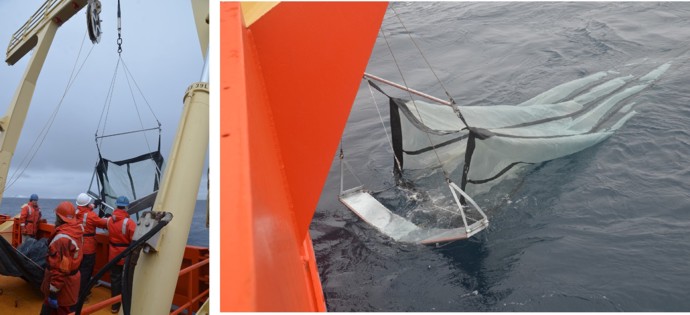
The Multiple Opening-Closing Net and Environmental Sensing System (MOCNESS) is launched from the LM GOULD. The nine nets are opened in sequence on the uphaul to sample discrete depths of the water column. You can see the cod ends (PVC buckets) at the end of the nets, which will retain plankton during the tow.  
Photos by Peter H. Wiebe

OCEANOGRAPHY IS A TEAM SPORT

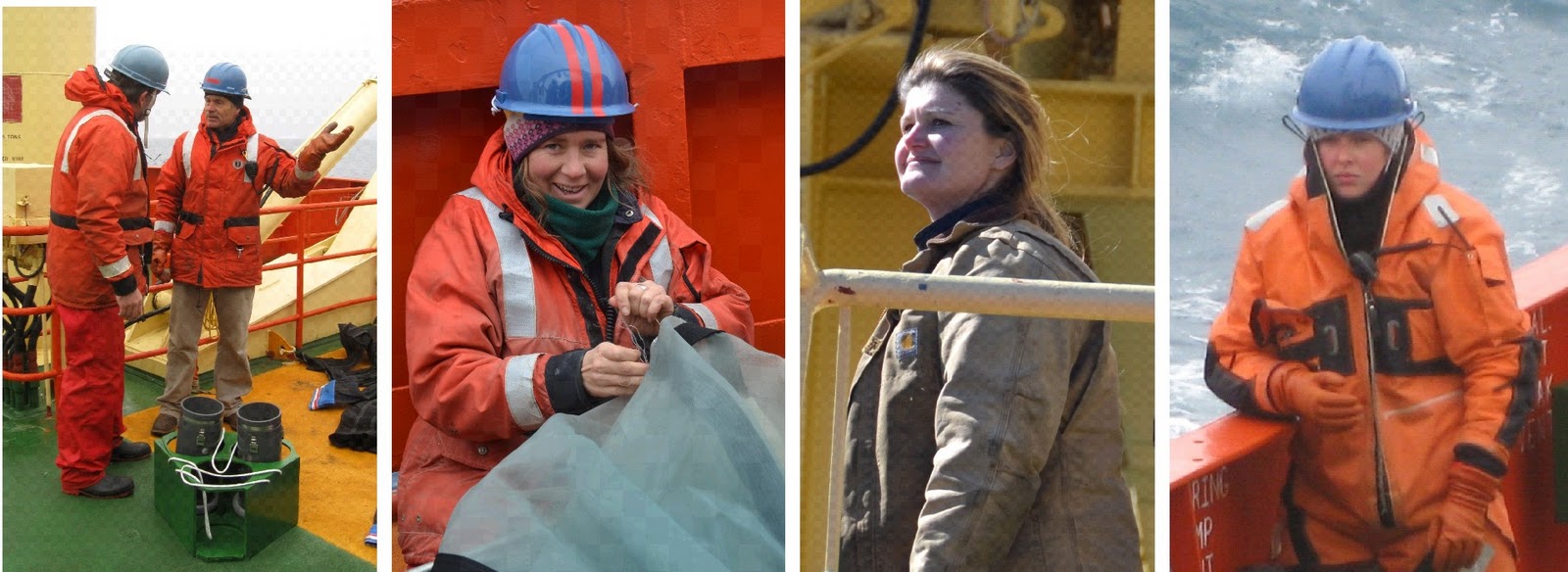
Oceanographers frequently work in teams to carry out both laboratory and field research. At sea, everyone on the ship must do their job well to ensure the safety of everyone and the success of the mission. For US Antartic Program (USAP) vessels, the Raytheon Polar Support Co. (RSPC) provides extensive technical and logistical support. This support is absolutely critical to the success of research on ships in the Southern Ocean and at research stations and camps on Antarctica. Here is a bit about the people on the LMG11-10 RSPC technical support team.

The RPSC team on our cruise on the LM Gould consists of the Marine Projects Coordinator (MPC), four Marine Technicians (MTs), one Marine Science Technician (MST), and two Electronics Technicians/Marine Computer Instrument Specialists (ET/MCIS).

Marine Projects Coordinator (MPC)

Jullie Jackson is the MPC for LMG11-10
The Marine Project Coordinator for our cruise is Jullie Jackson. She is the senior RPSC person on board and the liaison between cruise scientists, the RPSC staff, the ship’s Captain, and the port agent. She coordinates the support effort among the various parties involved. The MPC is the first contact for issues related to on-board operations, cruise plans, etc. Jullie stands a 12-hr watch everyday, but she is always on call and usually puts in very long days at sea.


MST Melissa Paddock brings extra sample jars for us – saves the day!
Marine Science Technician (MST)

Melissa Paddock is the Marine Science Technician. She is responsible for vessel lab operations and will assist cruise scientists with lab instrument set up, hazardous waste disposal, and sample packaging. The MST is responsible for ensuring that we follow proper safety procedures are followed at all times. Melissa helps us with all aspects of our laboratory work at sea.


Marine Technician (MT)

The Marine Technicians are responsible for deck safety and the safe rigging and deployment of all over-the-side operations. A well-equipped workshop is available for equipment repair, troubleshooting, and limited construction.

On our cruise, there are four MTs and they are very busy with a very wide range of tasks. The MTs are on deck during any gear deployment and recovery. They are responsible for checking the gear before it goes over the side. Between stations, the MTs have designed and built racks for our sample jars and water bottles, repaired nets that ripped during tows, and millions of other tasks that keep us in business.

Marine Technicians (MTs) for our cruise LMG11-10 are (left to right): Alan Shaw (at right in photo), Kelley Watson, Kari Anderson, and Krista Tyburski
Electronics Technicians (ET)

The Electronics Technicians (ETs) are responsible for all electronic scientific equipment and some ship’s operational systems. Our ETs are George Aukon and Kris Merrill.  They help with equipment set up and troubleshoot the electronics of all scientific. For our cruise, the ETs have worked hard to upgrade and trouble-shoot the MOCNESS, calbrate our acoustic profiler, setup a freezer van on the deck for our experimental observations of living zooplankton (think: cold!), and designed and rigged up recording temperature probes for our planned salp cultures. 

Left: ET George Aukon (left in photo) prepping the MOCNESS for deployment. Right: ET Kris Merrill getting the Biosonics echosounder ready for field calibration
Emergency Medical Technicians (EMT)

RPSC sails a minimum of one EMT on each cruise, and for our cruise both MPC Jullie Jackson and ET Kris Merrill are EMTs. Once the cruise is underway the EMT is the primary medical care provider onboard.  They are available to consult with anyone on aboard for any health or injury-related matters.

--------------------------------------------------

The RPSC operational and technical support team has been of invaluable assistance in every aspect of our cruise activities. As individuals and as a team, they are our source of expertise, knowledge, understanding, and wisdom, as well as lots and lots and lots of hard work!  Hats off and a big “thank you” to the entire team!

-- Ann Bucklin, University of Connecticut

Friday, November 11, 2011

Picture of the Day - November 11, 2011


AWAY AT LAST!  An LMG Zodiac plows through the waves toward Cape Shirreff, Livingston Island, Antarctica.  At the helm is Jullie Jackson (LMG11-10 Marine Projects Coordinator) with bowman Alan Shaw (Marine  Technician); their (happy if a bit damp) passenger is Mike Goebel, team leader for the NOAA Marine Mammal Observing Station, which was opened today and can be seen in the distance.

--Text and photo by Ann Bucklin

CAPE SHERIFF PUT-IN: FINALLY!

Yesterday we steamed back to Cape Shirreff to have another shot at bringing our resident seal and penguin biologists back to land.  We had been anticipating a “weather window” (the weather is anticipated to get rough again today, Friday) and wanted to take the opportunity to give it our best shot.   Sure enough, the conditions were much nicer than when we tried a few days earlier.  Much less of a swell and no fog!!  

Joe, Kelly, and Paola helping sort the “freshies” – fresh fruits and vegetables to help consolidate space in the zodiac.  Photo by Ann Bucklin
Unfortunately, the science party was unable to go to shore and help upload the zodiacs.  This didn’t stop us from helping, though!  We needed to move all of the food for the field camp for the next four months from the refrigerator and freezer and protect it from getting soaked with salt spray with plastic bags.  I was pleasantly surprised by the variety of food – everything from apples and oranges, to artichokes and leeks; chicken and beef, to conger eel and duck!  They even had a whole turkey – my guess is for Thanksgiving.   It looks like our friends will be eating well for the next four months!

The final zodiac leaving the LMG with Jullie, Alan, Mike, and the last of the supplies for Cape Shirreff.  Photo by Melissa Patrician
After about six hours of extremely hard and cold work by the MTs and ETs, we waved goodbye to the final zodiac and our new friends now at Cape Shirreff and are headed to our third science station!

The zodiac en route to Cape Shirreff.   Photo by Melissa Patrician

-- Katie Wurtzell, Stony Brook University

Thursday, November 10, 2011

Picture of the Day - November 10, 2011


View from the LM Gould steaming through Neumeyer Channel, Western Antarctic Peninsula Region. Photo by Peter H. Wiebe.

GETTING DOWN TO WORK

We heard the ship’s alarm at 0600 – and were delighted to be waked up this way! The weather had cleared enough to finish off-loading the cargo, including a large aluminum landing craft blocking the operation of the winch, and we were ready to go! The lines were dropped at 6:45 am (Fig. 1), and we got underway, steaming through the channel leading to Bismark Strait. Several small groups of penguins were on the small island across from the station. We headed east for the Neumayer Channel and then into the Gerlache Strait, heading back again toward our Station #22.

Figure 1. Lines were dropped in the early morning as we depart Palmer Station. Photo Peter Wiebe
The scenary was stunning and uniquely Antarctic (Fig. 2).  Sun was peaking out from behind the clouds giving rise to great highlights on the black rock walls along the channel and the thick sheets of ice and snow that cover most of the mountains. Shear cliffs of the ice several hundred meters tall mark the waters edge along the channel. Winds in the channel are much lower than in the open sea and are now less than 10 kts.

Figure 2. Our return passage through Gerlache Strait: a sparkling blue-and-white morning!  Photo Ann Bucklin
As we approach Stn #22, the MOCNESS was moved out to the stern, positioned for deployment, and given a last check by an Electronics Technician (ET; Fig. 3). All members of the science and RSCP technical teams worked this station. The station location was over a deep trough in the main channel that goes down to 1000 m. Our plan for the station work includes a CTD cast to 1,000 m, an IKMT tow, and finally the MOCNESS tow. Weather conditions looked good for our first station; the seas were very nice and the winds were light.

Figure 3. George Aukon (LMG ET) checks out the sensors and instruments on the MOCNESS. Photo Peter Wiebe
The station work proceeded according to plan and – as expected for a first station – everything takes an extra bit of time. The CTD cast was deployed from the Baltic Room through a huge door that opens in the side of the ship (Fig. 4).  The CTD rosette carries Niskin water bottles that can be “tripped” or opened at specified depths.  We tripped two bottles at each of seven depths from the surface to 1,000 m. The water samples were collected by the science teams (Fig. 5), and the water was filtered immediately for analysis at the UConn and SBU laboratories for chlorophyll, nutrients, particulates, and C:H:N ratios. Such biological characterization of the water column is critical to understand the “ecological niche” of our target species, the Southern Ocean salp, Salpa thompsoni.

Left, Figure 4. The CTD rosette with Niskin bottles deployed through the Baltic Room door of the ship. Photo Peter Wiebe. Right, Figure 5. Paola Batta-Lona (left) and Chelsea Stanley collect water samples for analysis from the Niskin bottles. Photo Ann Bucklin.
Immediately after the CTD cast, an Isaacs Kidd Midwater Trawl (IKMT) net was deployed from the stern and recovered after a tow to 175 m (Fig. 6).  This net is particularly useful for collection of living zooplankton, especially the fragile gelatinous salps that is the focus of our study. The catch in the IKMT was pretty light, with juvenile krill, amphipods, and several ctenophores and jellyfish, but no salps.

Figure 6. Deployment and recovery of the IKMT off the stern of the ship.  Left: A winch is used to lift the net over the stern gate of the ship, guided by the Marine Technicians (MTs) and scientists. Right: The recovery was made in calm seas; you can see the pentagonal mouth opening of the IKMT as it reaches the surface.  Photos Peter Wiebe.
After a break so everyone could eat dinner (quickly), we finished the setup and checkout of the MOCNESS and started the tow about 7:30 pm.  The MOCNESS can be controlled from computer on the ship, with commands sent down the conducting wire to the net. During the descent or downhaul, the first net, Net 0, was opened. At the bottom of the tow (at 822 m), a computer command was given to close Net 0 and open the next one, Net 1. During the uphaul, a total of eight nets was opened in succession to sample discrete depth strata through the entire water column: 822-600, 600-400, 400-200, 200-100, 100-75, 75-50, 50-25, and 25-0. The tow was carried out without difficulty and the MOCNESS was recovered about 10:30 pm (Fig. 7). No salps were caught and most of the zooplankton – juvenile krill – was in the upper 25 meters.

Figure 7. Left: Peter Wiebe (left), Joe Warren (center) and LMG Marine Technicians (MTs) ready for the MOCNESS for deployment at our first station. One cod end (in green racks) is attached to each of the nine nets. Right: The MOCNESS is recovered over the stern gate, requiring coordination by the Mate driving the ship, winch operator, and MTs. Photos Ann Bucklin.
Our work at Stn #22 – including clearing our gear off the deck, filtering the water samples, splitting and preserving the zooplankton samples, updating our data records and event logs, and cleaning up the shipboard laboratories – continued for several hours. We finished up just in time for “mid-rats” or Midnight rations, served for the ship’s crew, technicians, and scientists, who work as teams 24 hrs a day. After a quick debriefing in the mess, we headed for bed, while the Gould set course back to Cape Shirreff, a 9-hr steam. We hoped for good weather to allow the scientists to disembark via Zodiac and set up their summer camp.

-- Ann Bucklin (University of Connecticut)

Wednesday, November 9, 2011

Picture of the Day - November 9, 2011


After two days of storms, our return passage through Gerlache Strait is lit by sunshine reflecting off the ocean and surrounding peaks. A sparkling blue-and-white morning! 

Photo and text by Ann Bucklin